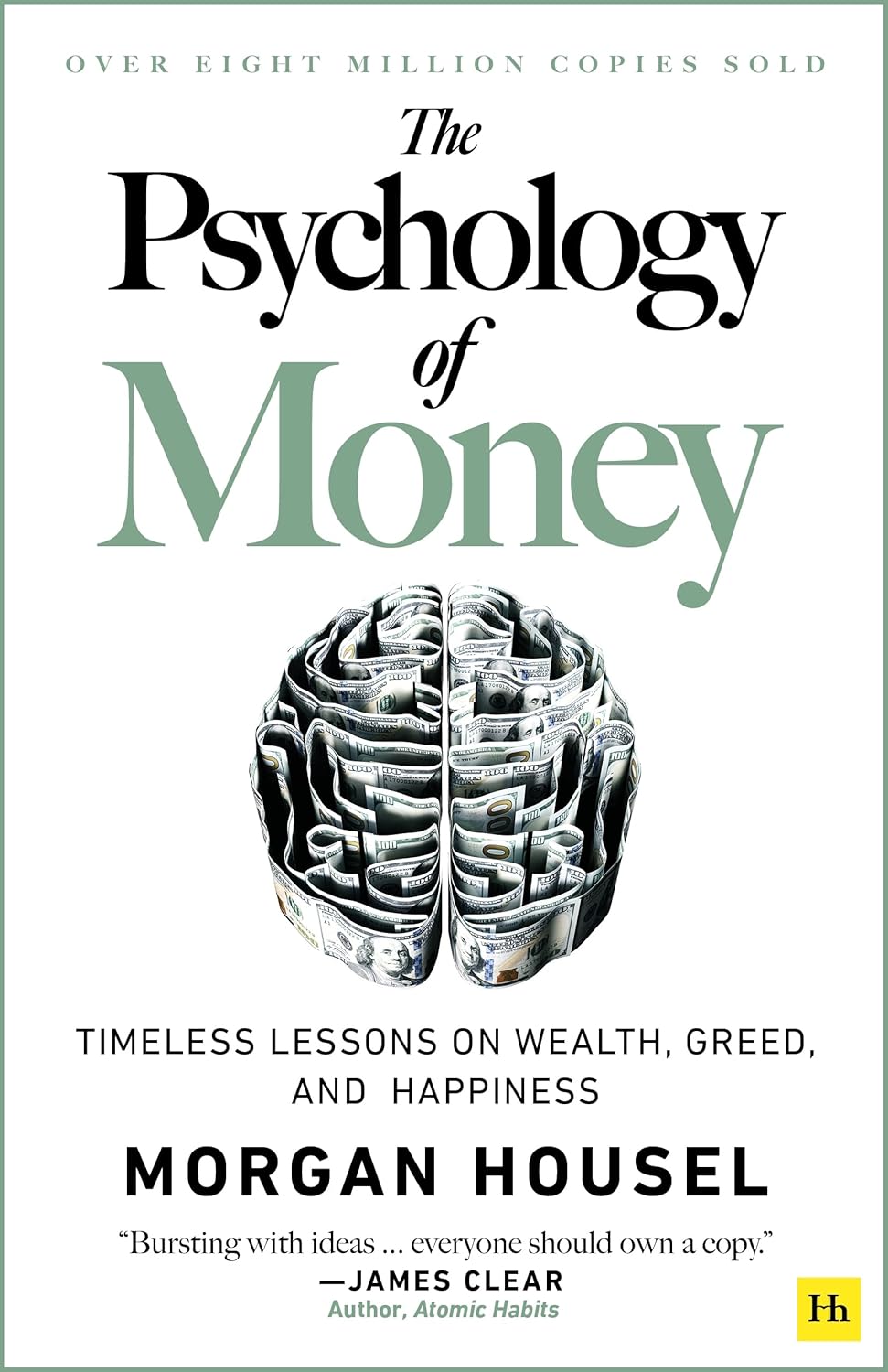
I heard Morgan Housel on the latest episode of the Shane Parrish podcast recently as well as a while ago on Vishal Khandelwal’s podcast, and most of what he said resonated with what I learned and found out on my own independently over the years.
So I went and got his book.
Take the best of Taleb, Danny Kahneman, and your grandma, put them into story form with an earnest tone, and you get this book. It’s lovely.
- Realise that you’re unique. You have your scars. Realise that colours everything that you see and do.
- Stop idolising individuals. The patterns lie in large numbers. Not in a single individual’s story, no matter how inspiring you think it is. You have no clue of which butterfly flapped its wings to create Bill Gates’ wealth.
- The aim ought to be enough. Which you get to decide. But there has to be a point where you say enough.
- The gains from compounding occur at the end. The only reason Buffett has the money he has now (~90 billion dollars), is because he started investing at 10. Had he started at 30, he’d only be worth ~20 million. Like Housel says,
Effectively all of Warren Buffett’s financial success can be tied to the financial base he built in his pubescent years and the longevity he maintained in his geriatric years.
His skill is investing, but his secret is time. That’s how compounding works.
- Making money is one thing. It’s the keeping of the money that’s harder. How does one do this? Stay in the margins. Survive. And use Taleb’s Barbell.
- Have options. You never know which one might pan out. Also realise that options are another way of saying that one of your individual bets could die for the sake of your bigger aim, and you’ll still be ok. An individual stock might not work, but the index has always inched upwards for decades.
- The best freedom, to paraphrase Taleb, is the ability to say, “Fuck this!” to things you don’t want to do. Or to actually quote him …
This kind of sum I’ve called in my vernacular “fuck you money” —a sum large enough to get most, if not all, of the advantages of wealth (the most important one being independence and the ability to only occupy your mind with matters that interest you) but not its side effects, such as having to attend a black-tie charity event and being forced to listen to a polite exposition of the details of a marble-rich house renovation. […] Beyond a certain level of opulence and independence, gents tend to be less and less personable and their conversation less and less interesting.
Housel puts it much more eloquently …
The highest form of wealth is the ability to wake up every morning and say, “I can do whatever I want today.”
People want to become wealthier to make them happier. Happiness is a complicated subject because everyone’s different. But if there’s a common denominator in happiness—a universal fuel of joy—it’s that people want to control their lives.
The ability to do what you want, when you want, with who you want, for as long as you want, is priceless. It is the highest dividend money pays.
- Stop playing the Keeping up with the Kumars1.
- Save money.
- Being reasonable is greater than being rational.
You’re not a spreadsheet. You’re a person. Do not aim to be coldly rational when making financial decisions. Aim to just be pretty reasonable. Reasonable is more realistic and you have a better chance of sticking with it for the long run, which is what matters most when managing money.
- You cannot spend your time and energy watching the world and waiting for the “best” time to make a investment. Save money. Invest it. Let it compound.
- Margin of Safety. That ought to be one of the main weapons in your mental arsenal. Always have room for error. Always have slack.
- You will change over time. Learn to be kind to your future self. Make sure you’re not wedded to past decisions. Make your circumstances adapt to you.
- Nothing’s free. What are you willing to pay to get what you want?
- Note to self: Learn Statistics. Learn probabilities. They’ll teach you more than stories that folks weave. And yet paradoxically, when you want to convince folks? Use stories. They are always more powerful!
- Manage and invest your money in a way that helps you sleep at night.
- The best “shortcut” to do better with your investments? Increase your time horizon and let compounding work for you.
- What works for others will not work for you. They are not you. Make your own mistakes. And your own decisions. There is no single right answer; just the answer that works for you.
Feedback on this post?
Mail me at feedback at this domain.
P.S. Subscribe to my mailing list!
Deep cut silly joke, if you loved the Kumars and Goodness Gracious me.
The Jones at No. 42 were Indian. ↩︎