Crazy work month. Tonnes of travel.
So a lot of books this month are comfort rereads.
I’m averaging about ten books a month, so I’m assuming the habit and the consistency have come back. I’m so glad!
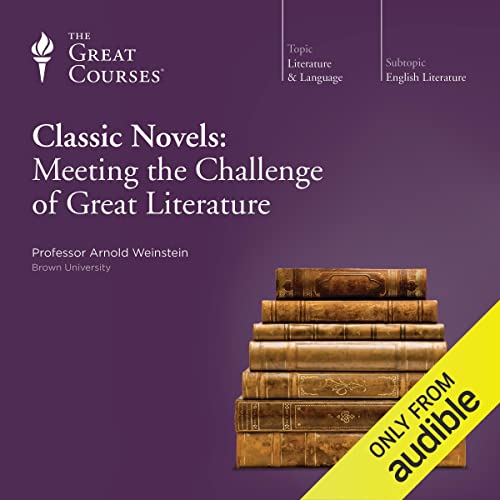
Classic Novels: Meeting the Challenge of Great Literature, Arnold Weinstein (The Great Courses)#
Like Professor Weinstein says, “[the classics] challenge us to wake up, to enter into their depths, to partake of the
life they contain.”
And so, the course goes into a wide ranging excursion, beginning first with what literature is, its importance and its relevance.
Why classics?
Classic novels are books that invariably surprise us by destabilizing much that we thought firm and in place. It’s true that art embodies order, but at the same time, it explodes our paltry notions of order. It tells us that life is far more provocative and bristling and fascinating and unruly than our narrow definitions usually allow.
as well as …
classic novels are not simply a means for us to experience faraway places. These texts still speak to us today, functioning as mirrors for us and for our moment. Moll Flanders, for example, speaks to the battle of women to find a legitimate place in society; Bleak House offers a frightening view of still-unsolved problems and crises of urban culture
After a few chapters of such discourse, it then spends a chapter each diving into classics1 across the centuries, from 18th century France and Laclos’, Liasons Dangereuses to 19th century Emily Brontë’s Wuthering Heights and ending in the 20th century with Gabriel Garcia Marquez’s One Hundred Years of Solitude with Defoe, and Balzac and Tolstoy and Dostoevsky and Conrad and Proust and Joyce and Woolf all making appearances.
Thoroughly enjoyable!
Writing Great Fiction: Storytelling Tips and Techniques, James Hynes (The Great Courses)#
This one felt like all the courses of the past few months, being brought into a coherent whole to serve as tools for writing. Round and Flat characters, dialogue, plotting, complex plotting, points of view, research and everything else that goes with it.
I loved one of Hynes’ reasons to write:
One final reason to write is to erase onself in the creative act. […] our live-wire awareness of everything around use and the constant hum of our own imaginations cause use to crave some sort of peace. Writing itself is an intensely self-conscious act, as you find yourself inhabiting the minds of your characters and forcing yourself to think about things that most people never think about at all. The paradox is that most writers find respite form this acute self-consciousness in the act of writing itself.
[…] This is not the same thing as reading for escape, where your mind switches off and lets the narrative play as if on a screen. Rather, it’s the experience of fully inhabiting another life or world, where your mind is fully engaged—but not as yourself.
[…] the most sublime experience in writing comes when you feel as if you are remembering the book, not creating it. It is as if the book is out there in the ether someplace, and you are simply recording what you have heard. When you’re finished, you feel relief that what’s on the page at last matches the melody in your head, the one only you can hear.
How to Publish Your Book, Jane Friedman (The Great Courses)#
I really did go overboard this month with the Great Courses. This was the final one for the month.
If you ever wondered about the effort and toil required to write a book, then this lays it all out for you. In structured, exhaustive detail.
Friedman leaves no stone unturned. The whole edifice that is the cathedral called book publishing is examined at length. What is fiction writing like? What goes into non fiction? What does an agent do for you? What are the various book lengths? What time frames are you looking at for various goals? What is the industry broadly like today? Is self publishing really the panacea that it seems? What is a platform? Is it just social media? Justice is done to all these topics, and more.
This also lets you decide on whether your dream of actually writing a book, is worth it after all? Or does it need to take a another shape or form?
I wish more books and courses were as well put together as this one was.
Punjab, Punjabis and Punjabiyat: Reflections on a Land and its People, Khushwant Singh#
Some history, about a people who have always fascinated me, since in way, I was brought up in my early working years by a coterie of folks who either were from, or were descendants of the people of the Punjab. Stories of partition (Burma from my grandfather and Punjab from an old neighbour) have also made me curious about the land and its history.
The first part is a rapid, sweeping history of the region, by one of its famous and controversial sons made sense. From its ancient origins to the founding of the Sikh faith, the beginnings of the language and its literature, its place in the British empire and the enduring spirit of its people. I was raised on Khushwant Singh’s columns2 as a youngster, so reading this felt like coming home, in more ways than one.
The second and third parts are a series of essays, slices of life from Khushwant Singh’s life and experiences and biographies of various notables through time.
Loved the book. It gave me a really warm nostalgic feeling. Here’s Singh, on the monsoons in the region:
Punjabis, who have to live through many months of intense heat every year, love the monsoon. It is the time for lovers’ trysts and the reunion of families. Guru Nanak went into raptures over it: ‘The season of the rains has come and my heart is full of joy…river and land are one expanse of water… The nights are dark. Frogs croak in contentment. Peacocks cry with joy. The papeeha calls peeooh peeooh. The fangs of serpents and the stings of mosquitoes are full of venom. The seas have burst their bounds in the ecstasy of fulfilment.’ Life begins afresh. There are new leaves on many trees and grass covers the barren ground. Mangoes ripen. The clamour of the koels and the brainfever bird is drowned in the song and laughter of girls on swings in the mango groves. By the time the monsoon is over, it is cool again.
Blood Over Bright Haven, M. L. Wang#
This felt like a modern spin on a short story from those old sci-fi stories from the 60s. Only less sexist. More sensitive. With more wisdom. And gorgeous prose.
It’s the standard schtick. Protected City. Wasteland earth. Salvation and safety lies within.
Or does it?
What the book is, is a standard plot, with pitch perfect execution. And like I said, lovely prose!
A few tidbits:
Some last autumn in Thomil’s expression froze over.
This was how the Caldonnae truly died.
In pain too big for two small souls to bear without corruption.
Sciona had already swept down the hall, a plan crackling on the kindling inside her.
Fire filled the void.
Address Unknown, Kathrine Kessman Taylor#
An tiny, tiny, epistolary novellette set during the horrors of the second world war.
And a book that filled me, paradoxically with both tremendous sadness and cacklingly evil glee.
And that’s all I’ll tell you. Go read it yourself.
A Red Sun Also Rises, Mark Hodder#
A story within a story. A red sun. Aliens of various kinds battling each other. Rip roaring fun!
A Walk in the Woods: Rediscovering America on the Appalachian Trail, Bill Bryson#
Bill Bryson walks the Appalachian trail.
Bill Bryson is a fount of entertainment.
Bill Bryson wrote this book, combining the two statements above.
Live. Laugh. Love. Laugh some more. Get cranky. Get blisters. Roll on the floor laughing. Find out about a beautiful, wild part of the USA3, in a really entertaining manner from a Brit. Grin like a mad man as you remember something funny from the book.
The Copper Beeches, Sherlock & Co. Podcast, Season 48#
Our intrepid trio mucking about the grounds of a mansion. Electric blue dresses. And a crabby, crabby woman.
There’ll be such a hole when this show ends! I love their interpretation of the canon.
The Wit & Wisdom of Tyrion Lannister, George R. R. Martin#
A collection of Tyrion quotes from all the five books.
Here’s a few:
All dwarfs may be bastards, yet not all bastards need be dwarfs.
I’m short, not blind.
I have a tender spot in my heart for cripples and bastards and broken things.
My mind is my weapon. My brother has his sword, King Robert has his warhammer, and I have my mind … and a mind needs books as a sword needs a whetstone if it is to keep its edge.
A Lannister always pays his debts.
Made for a lovely end to the month.
P.S. It’s been three years today, since I lost my younger sibling. I still miss him.
Feedback on this post?
Mail me at feedback at this domain.
P.S. Subscribe to my mailing list!