Same situation as last month. Occupied with personal issues. So lots of reading got done.
The themes for the forseeable future though, are
- to keep going back into the past to find gems that I can escape into,
- and to find literary gems with exquisite prose and literary techniques that I enjoy, no matter new or old.
Death of an Expert Witness, P. D. James#
I somehow stumbled into what I’d call cozy Le Carré.
It’s ostensibly a murder mystery, but it’s as bleak as any Le Carré as I’ve ever read.
Slow, deliberate, pacing and lovely prose. Multiple points of view. Each one pretty detailed. Somehow it’s more a character study than detective fiction. And it’s lovely. The ending was so inhumane to my eyes; to have a life extinguished just like that was monstrous and nihilistic and random all at once. I don’t think I’ll be reading any more of P. D. James. One Le Carré in my life, is enough.
Writing Down the Bones, Natalie Goldberg#
This, along with the next few books are my learn to write better section.
Writing down the bones speaks in the same vein as Anne Lamott’s, Bird by Bird.
Start small. Write consistently. The work and the journey, are all that you can controly. Learn to love your craft.
It’s aimed at folks like me, not the pros. Basic writing advice. Delivered in a gentle and encouraging voice.
I loved it.
One of the main aims in writing practice is to learn to trust your own mind and body; to grow patient and nonaggressive.
Art lives in the Big World. One poem or story doesn’t matter one way or the other.
It’s the process of writing and life that matters. Too many writers have written great books and gone insane or alcoholic or killed themselves. This process teaches about sanity. We are trying to become sane along with our poems and stories
Our senses by themselves are dumb. They take in experience, but they need the richness of sifting for a while through our consciousness and through our whole bodies.
I call this “composting.”
Our bodies are garbage heaps: we collect experience, and from the decomposition of the thrown-out eggshells, spinach leaves, coffee grinds, and old steak bones of our minds come nitrogen, heat, and very fertile soil. Out of this fertile soil bloom our poems and stories.
But this does not come all at once. It takes time.
Continue to turn over and over the organic details of your life until some of them fall through the garbage of discursive thoughts to the solid ground of black soil.
How to Read a Book: The Art of Reading & Dialogues about Books, Mortimer Adler & Charles Van Doren#
This was a life changing book for me. It taught me to look at reading differently.
As an art. And an craft. Before this, I was just an organic reader, and read whatever came my way.
How to Read a Book gave me a greater appreciation for books and for reading, and gave me the tools to tackle “difficult” books.
What I have linked to above though, is a three hour video of the two authors, sitting and having fireside chats. It compresses the ideas in the book into a three hour video.
If a vintage video of two white men, sitting at a desk, smoking cigars and talking about books appeals to you, then this is just the ticket. Even if it does not, and you love reading, I’d urge you to still give it a chance. The ideas are good.
Analysis and Critique, Dorsey Armstrong, (The Great Courses)#
This course is what I’d describe as a good allrounder.
It deconstructs prose and teaches the basics of reading and writing.
How to read effectively, how to find your own voice, how to develop your taste and your voice, how to write, knowing your audience … Dorsey Armstrong tackles it all and does it efficently and effectively.
Becoming a Great Essayist, Jennifer Cognard-Black, (The Great Courses)#
A course on writing essays, in the form of lessons that are very thoughtful and … “essayic”.
This one goes deep into writing short non fiction of all shapes and sizes. Memoir, Epistolary, Polemics, funny essays, specialised essays, you name it.
It taught me how to visualise things and write them down. It taught me that I cannot ever hope to write everything about everything; that one is constrained by their innate humanness and by nature at large.
Lots of mental models on writing and observing, all in a tidy, neat, package.
Practicing these lessons, I hope, I hope … that I’ll be able to write better posts here.
Sherlock & Co. Podcast#
These are my greatest allies in escapism right now! Where would I be without the merry company of Ametxazurra, Watson & Holmes?
The Greek Interpreter, Season 45
We meet Mycroft! Murder and mayhem ensue! ’Nuff said!
The Engineer’s Thumb, Season 46
This is their spin on King’s IT, without the supernatural aspect. It’s dark, a woman gets her finger amputated1, and it has multiple points of view.
A World is Born, Leigh Brackett#
A short novella, set on the slave gulags of Mercury! You can read it on Gutenberg.
It’s thrilling and formulaic, yes, but it is thrilling and formulaic with great execution. Like Robert Rodriguez and Sin City.
I wanted Leigh Brackett to have the heroine have more agency, but she was writing to the beats of the time. If you like old Clarke and Asimov stuff, you’ll love this.
Pirates of Venus, Edgar Rice Burroughs#
I want to read the Mars novels again, but there are too many of them, so I decided to read his Venus novels. There are only three of these. Burroughs, most of you would know from Tarzan. So take an 80s action movie with himbos and transplant them to other worlds, use wildly inappropriate stereotypes2 and florid yet relentless, driven, prose.
Carson Napier, shoots for Mars in his spacship, but miscalculates and then is driven towards the sun and crash lands on Venus.
Venus has life! There are humans there as well! And all sorts of strange flora and fauna.
For all its flaws, it’s great fun! Old sci-fi was quite something! :)3
D’Aulaires’ Book of Greek Myths, Ingri & Edgar Parin d’Aulaire#
Yes, I’ve been swept up in Greek classic myth fever as well! But it owes less to Nolan’s Odyssey and more to the Lady of the Library’s (Cinzia DuBois) videos on the classics.4
Anyway, I just wanted my head screwed on straight, with respect to the various gods and goddesses, and the titans and the nymphs, before I started with the Illiad.
This book tells you all! It purports to be a children’s book, but when has that ever stopped me?5 😂 It’s a slim book with gorgeous art.
I will always remember the day I read it, as a wonderful memory.
Joyce’s Ulysses, James A. W. Hefferman, (The Great Courses)#
This is my preparation for tackling the modern version of the Odyssey.
I want to enjoy the first time I read Joyce. I know it will be a head scratcher6, but I felt it would be less of a head scratcher if I learnt about the mores and customs and the what’s what of early twentieth century Dublin. I started it on Bloomsday, and finished it this month. I want to someday learn to use allegory as well as Joyce did with this book.
Hefferman was excellent at taking the fear of tackling Joyce, right out of my mind. He was so engaging, I was sad, everytime I had to lay the book down.
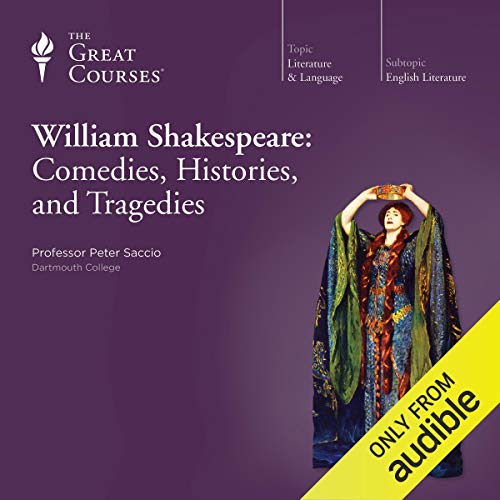
Shakespeare: Comedies, Histories and Tragedies, Peter Saccio, (The Great Courses)#
And finally, why not shoot for the stars, when it comes to beautiful language, and tackle Shakespeare? So, Peter Saccio was my guide through slightly less than half of his plays. He tackles all the hits. Julius Caesar, Macbeth, Hamlet, Romeo and Juliet, Othello, they’re all in here.7
Context, history, the meaning of difficult words, actually acting out portions of the plays … Peter Saccio is a genius. The hours just flew by, when I was listening to his voice. He really made Shakespeare come alive for me.
P.S. Speaking of something that matches everything I’m looking for, Sara Bareilles’ new video, Still Crying is it.
It escapes into an ole timey video, with a slow doo wop melody, with beautiful lines (Teach me how to see again. Touch me with technicolor rain) and rendered with exquisite craft. Her voice is an instrument!
It’s a lovely, lovely song.
Feedback on this post?
Mail me at feedback at this domain.
P.S. Subscribe to my mailing list!
as opposed to a little boy and his poor arm, in the original ↩︎
which even the 80s movies had ↩︎
Burroughs, of course is no Verne. There is more fi, than there is sci in his stories :) Burroughs in Venus is also not as good as Burroughs in Mars! ↩︎
Yes, there might have been a few more well timed videos to go with the movie, but the lady is amazing and has been speaking about the classics for quite a while now. ↩︎
and honestly, it isn’t just for kids. Put simply, I think it works better for the parent, than the child. ↩︎
Reading Harrow the Ninth has been good prep for a story, that makes no sense ↩︎
I missed Coriolanus, the only Shakespeare play I have ever watched ↩︎