Lots of work this month.
Tried to keep reading on an even keel, on slow regular cadence in addition to reading in the cracks of time.
Coffee and Audiobooks in the morning are such a pleasure.
Building Great Sentences, Brooks Landon (The Great Courses)#
While learning about Danté1 is defintitely more important and why I did this course, Building Great Sentences, will probably be the biggest skill I pick up this year.
I loved it so much that I bought both, the book and the course.
It finally unveiled to me, just what was involved in constructing a beautiful sentence, and why the aim is always to write longer sentences. The trick, the turn, if it be called that, is the skill involved in constructing the long sentence, using the best possible vocabulary and rhythm to deliver the prestige: a beautiful line of prose.
Word choices, depth of clauses both vertical and horizontal, the inseparability of form from content, the importance of rhetoric over grammar and much, much more. For folks like me, who want some tools, (of the folks studying and writing good literature,) to express themselves more eloquently, this book really is godsent.
Writing for Developers, Piotr Sarna & Cynthia Dunlop#
This gave me another set of skills, that of writing technical blogs. Not that I am going to use this on the current blog, (I am defintitely not the target audience) but this is another set of knives in the toolbelt.
Lots of tips and tricks and scaffolding and templates and handholding on how to write a “modern” technical blog. Specially helpful for folks, who use English as their secondary, tertiary or quaternary language and yet have to write blog posts or documentation to support their code.
Disney, Part I & Part II, Acquired Podcast#
Lovely history of Disney and Co from Walt all the way to the modern day. I don’t know if there will be a follow up, but these episodes cover a fairly large block of time. Leans hagiographic as Acquired is wont to do. Lots of Disney villainy, specially towards creative folk, is swept under the rug.
The Boscombe Valley Mystery, Sherlock & Co. Podcast, Season 47#
Dr. Watson gets into a funk, gets really grumpy, kills a fatuous, smug, arsehole and then gets thrown in the slammer.
Find out how our duo fares in Season 47! This one was on the lighter side; not too heavy (excepting the murder, of course.)
Absolution by Murder, Peter Tremayne#
Sister Fidelma, the Irish nun, solves a murder mystery at the dawn of Christianity in seventh century Northumbria. For someone so ancient, Sister Fidelma comes across as quite modern. I love the writing and the history and the exposition. I love the world. And while you’ll probably see the murderer from a mile away, I also love that the cause seems both quite modern as well as something as old as time. Very, very, enjoyable.
The Silver Pigs & Shadows in Bronze, Lindsey Davis#
And now, to go even further back in time, to the Roman Empire to solve even more murder!
Nero is dead. Three more emperors die in quick succession before commonplace Vespasian wrests control to begin the Flavian dynasty.
And in the centre of this hot, boiling, odorous, unsettled mess that is the city of Rome, is informer2 and later imperial agent, Falco. Contrary to modern noir tropes, Falco matches the messiness of Rome. He has a large family that is always underfoot, is social and works with everyone he possibly can.
The stories themselves range from Rome to ancient Britain to Magna Graecia (southern Italy) and back. There are all sorts of shenanigans. Mischief, murder, mayhem and everything in between. The two books have two murders, yes, but the bigger arc feels like a single novel. These c(sh)ould be read like a duology.
The language is beautiful. It feels very much like how I would write, if I could write well. It’s slightly curt, just like me. There are plenty of things left unsaid for folks to find if they wish to. I loved it!
“Lie still, Falco; don’t make such a fuss…” The dependable vindictiveness of Helena’s voice swung with me through delirium. To a freed slave, tyranny can be oddly comforting.
I have no intention of describing what happened next. It is private between me, the senator’s daughter, and the gardener’s horse.
[Reading this below, on my father’s birthday … this really struck home — mjb]
My mother’s face would never age. Only her skin had grown tired in recent years, so it no longer fitted properly on her bones. After I came back from Britain she seemed smaller than before. Her black-rimmed eyes would stay bright and sharp-witted to the day she died. One day that would happen, and though I now spent so much effort fending off her encroachments, when she was gone I would be desolate.
I bought a pancake stuffed with hot minced pork which I ate as I walked. A watchdog wagged his tail at me but I told him to take his smiling fangs elsewhere.
Life is unfair. Too unfair, too often, to ignore a friendly grin; I went back and shared my pancake with the dog.
Sometimes I stood at the sea’s lisping edge …
How to Read and Understand Shakespeare, Marc C. Conner (The Great Courses)‡##
More study on how to engage with the bard. This course focuses on the tropes and techniques across Shakespeare’s plays and helps us see them, so that we can enjoy and engage with the plays even more. Here’s one called …
Words, Words, Words!#
One of the essential keys for unlocking Shakespeare is the way he uses words. We will call this the “words, words, words” tool because when Hamlet is asked what he is reading, he responds, “Words, words, words.”
How does Shakespeare use these words? Shakespeare uses language in figurative ways, meaning that the language is representative, symbolic, metaphorical; in other words, he uses words to mean something other than their literal meaning.Pay close attention to how Shakespeare explores and exploits the many meanings of words. Where does he make puns—that is, highlight the double meanings of words? Where does he employ obviously poetical language, and where does he use language that is quite ordinary and familiar? What does he gain by this? How does he use particular aspects of language—the speech of lower classes, prose versus poetry, high poetic language of true love, the Shakespearean sonnet, etc.—to attain his meanings? What do readers need to know in order to understand Shakespeare’s language?
Romeo looks up and sees a light. Well, sure, Juliet’s bedroom candle is burning. However, Romeo does not stop at that literal meaning. The window, he says, is the eastern horizon, and the light he beholds is the sun rising—which, he says, is Juliet herself.
What is gained by using language in this way?
What is gained is precisely a surplus of meaning—larger significances than the literal words would allow.
- If Romeo is telling us that Juliet is now his sun, this means that she has a cosmic significance to him, and indeed, a few lines later, he compares her eyes to stars and says that they could burn “so bright that birds would sing and think it were not night.”
- Juliet even becomes a goddess to Romeo, just as primitive people once worshiped the sun. Indeed, later in the play, Juliet calls Romeo “the god of my idolatry,” which is a dangerous confusion of the love one gives to a person with the love one gives to God.
- In almost the very last line of the play, the prince says, because these young lovers are now dead, “The sun for sorrow will not show his head”—as if the light that was embodied in Juliet has now been extinguished. All of these meanings are suggested in the first small comparison Romeo makes with his language: “It is the east and Juliet is the sun.”
Romeo says one thing and means many things. It’s one of the major tools to keep in mind with Shakespeare: His language means more than one thing and works on more than one level of meaning.
Romeo says: “It is my lady, O, it is my love!” This simply means that the girl he beholds is the girl he adores. Shakespeare alternates lines fraught with condensed, poetic meaning with lines that mean pretty much exactly what they say. Usually, the characters that are most interesting move back and forth between figurative language and literal language.
When Juliet first speaks from the balcony, her initial words are a succinct statement of the whole problem of the play: that she is of the Capulet family and Romeo is a Montague, the sworn enemies of the Capulets.
O Romeo, Romeo, wherefore art thou Romeo?
Deny thy father and refuse thy name.
Or if thou wilt not, be but sworn my love
And I’ll no longer be a Capulet.“Wherefore art thou Romeo” means “Why are you named Romeo?”
This problem of the name strikes Juliet as an odd thing: If she loves Romeo and Romeo loves her, why should mere names be such a problem? She moves into her own meditation on, in fact, language itself.What’s in a name? That which we call a rose
By any other word would smell as sweet;
So Romeo would, were he not Romeo call’d,
Retain that dear perfection which he owes
Without that title. Romeo, doff thy name,
And for thy name, which is no part of thee,
Take all myself.Juliet is taking on the very problem of Shakespeare’s words: Why use one word rather than another? What difference does the word make? What’s in a name? If this play tells us anything, it tells us that we cannot simply abandon the meanings words have. Romeo and Juliet struggle mightily to escape the fate that their family names demand, and the tragedy of the play is that they cannot do it. Words, Shakespeare tells us, are of enormous, life-changing, world-shaping importance, which is another reason why Shakespeare tries to bring out their power through his figurative language.
Shakespeare’s central focus on language also takes the form of an extended conceit, or poetic analogy, such as when Romeo meets Juliet at the ball. Pay close attention to how this comparison in words functions. What does the comparison tell you about Romeo and how he feels toward Juliet? What does Shakespeare gain by using language in this way?
Shakespeare’s language can at times depend on archaic or lost words for a contemporary audience. Readers need to look up some of his strange or historically distant words. Think about how these words contribute to Shakespeare’s meaning.
Twelfth Night, or What You Will, William Shakespeare#
So I finally took all that Shakespeare learning and tried to read my first Shakespeare.
I watched the play first and then went on to read it. Shakespeare Network is an splendid place for lots of really good performances.
The play is lovely. Now I know, why Shakespeare is Shakespeare and why the plays have been copied and adapted over and over, over the millenia.
I loved the language. I loved the prose and the poetry. I loved the characters. I loved the play. And I’m going to love rereading this again next month.
I read the Arden edition of the play which has copious notes and context, which I haven’t read yet. Going through those and then reading the play again, should be fun.
A thought that struck me reading this, is that things of art, of beauty, of remembrance come from hard, blue collar work.
The product might be enduring and beautifully wrought, but it’s made in the dirt. By flawed, human people crafting things bit by bit. Shakespeare struck me as such a man.3
One example of his earthy vulgarity was Malvolio finding the planted letter and then going: “By my life, this is my lady’s hand. These be her very C’s, her U’s and her T’s, and thus makes she her great P’s.”
Mania for Subjugation IV, Hardcore History, Episode 74#
Four very enjoyable hours. Alexander takes Turkey. Darius the Third, escapes.
And that is all I will tell you about this episode!
The history is known. What you have to experience is how Dan brings it alive :)
Classical Mythology, Elizabeth Vandiver (The Great Courses)#
I found another primer on the classical myths of the Occidental world.
This is the big girl edition of D’Aulaires’ Book of Greek Myths that I read last month.
Elizabeth Vandiver covers all the big stories, and grounds them in history wherever possible.
I loved her definition of a myth: “traditional stories, a society tells itself that encode or represent the world-view, beliefs, principles, and often fears of that society.” When seen through this lens, lots of “weird” things about myths suddenly start to make sense. She also makes the point that no culture, thinks of their myth as myth. To them it’s just the daily truth; an account of the way things really are.
This was a wonderful introduction to the old western world. I just wish I can find something like this for India (the subcontinent as a whole) as well!
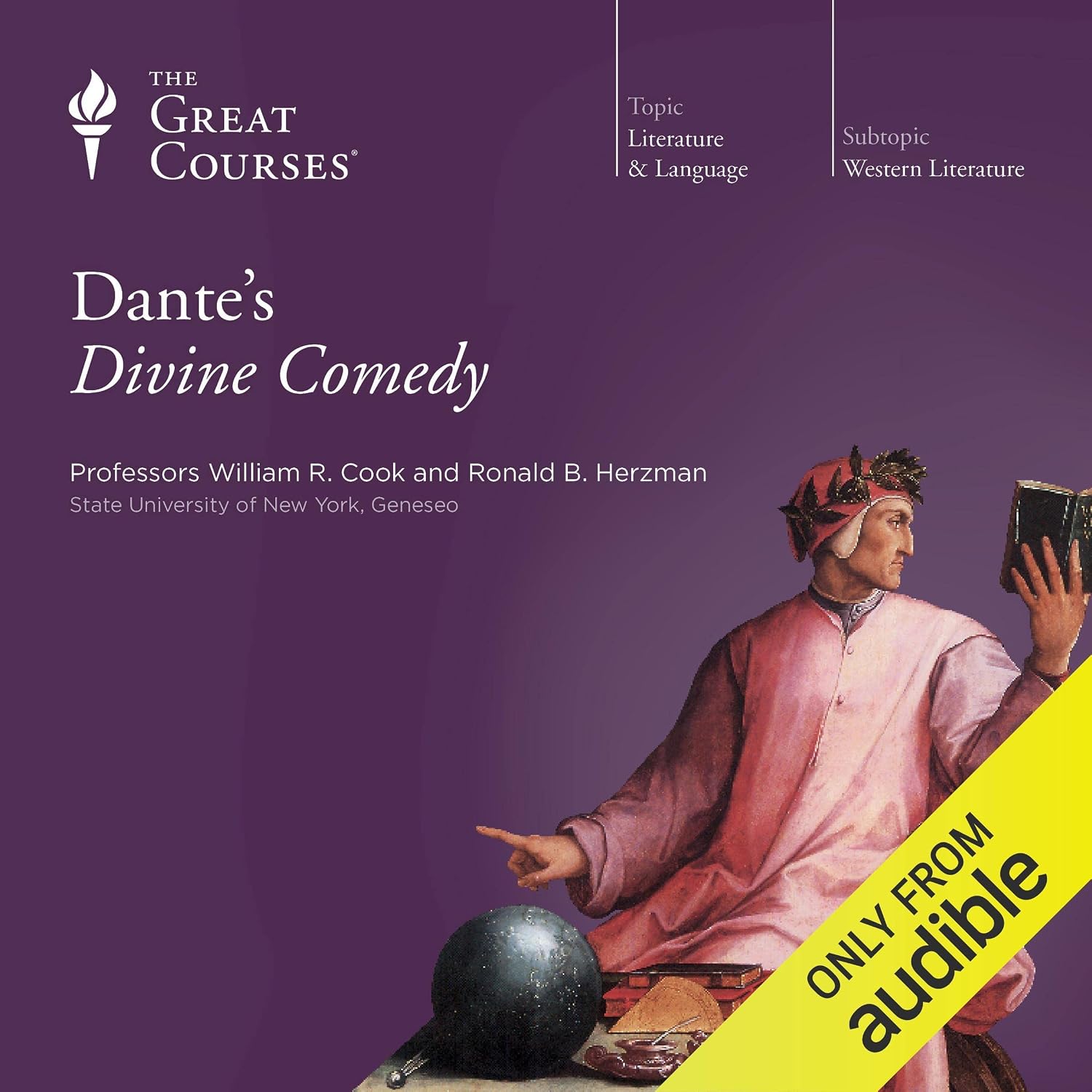
Dante’s Divine Comedy, William R. Cook & Ronald B. Herzman (The Great Courses)#
This is the one that I really sank my teeth into, because I have had a copy of the Comedy in my shelves for years and I have been scared to go read it. And then to add to it, I bought myself a handmade coffee table edition of the Comedy (with gorgeous Gustave Dore artwork) in French, earlier this year.
So Cook and Herzman were my guides through Dante’s voyage through the Inferno, Purgatario and Paradiso.
And in a word, this was what I was looking for all my life.
Something based on the Christian faith I was born into, and the Greek and Latin4 myths I grew up with, the philosophers whose quotes were pounded into my head as a kid5, all painstakingly crafted with symmetry in a gorgeously fashioned poetic structure.
And going through the course, I realised that Danté “spiced” things up by adding gossip from all over in his day and age. There are popes and politicians and poets and pariahs, saints and sinners, and of course the Devil and God.
I might never get to reading it in all its poetic glory in Italian, but at least I can now read it in English and French. Twice is nice :)
Also someday, I hope to make a pilgrimage to Florence and Ravenna.
P.S. If you want to watch a Shakespeare play, and you don’t know which one, here’s a handy-dandy flowchart from Good Tickle Brain.
Feedback on this post?
Mail me at feedback at this domain.
P.S. Subscribe to my mailing list!